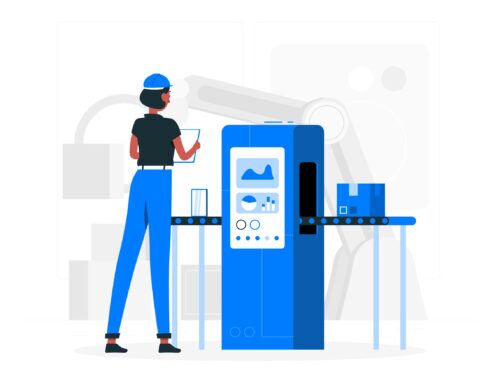
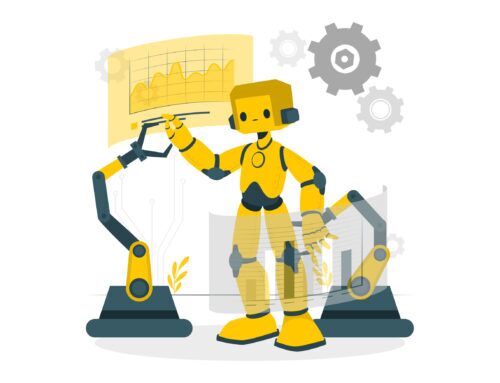
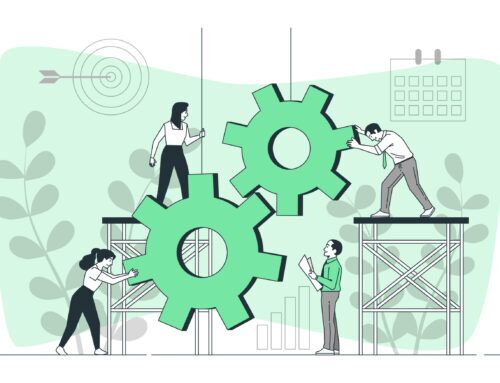
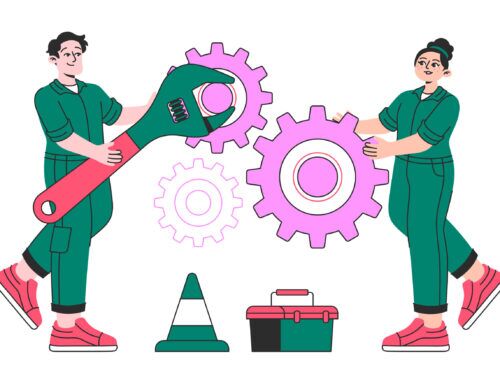
Industry 5.0 is reshaping the aftermarket far beyond incremental automation. In spare parts and service, the agenda is no longer just about digitizing processes; it is about orchestrating a new equilibrium between human judgment and machine intelligence. AI-driven demand forecasting, intelligent spare parts pricing, and collaborative robotics in warehouses are now technically mature. Yet adoption remains uneven.
Author Copperberg Editorial Team | *This article was developed using a combination of human expertise and AI-assisted writing. The concept, structure, and editorial direction were defined by our team, while elements of the text were generated with the support of advanced language tools. All content has been reviewed, refined, and approved by humans to ensure accuracy, clarity, and relevance.

Photo: Magnific
What becomes increasingly evident is that the limiting factor is not technology, but organizational change. For aftermarket leaders, the strategic question is not “Which tools?” but “Which behaviors, structures, and culture will allow human and machine capabilities to reinforce each other at scale?”
Three imperatives are emerging as decisive: reframing leadership around human–machine collaboration, industrializing workforce adaptability, and managing cultural shifts with the same rigor as operational KPIs.
From Technology Sponsors to Behavior Shapers: Redefining Leadership in Industry 5.0
In many spare parts organizations, leadership support is still equated with signing off on budgets and attending steering committees. In an Industry 5.0 context, this is insufficient. Leaders must consciously shape how people experience human–machine collaboration in their daily work.
This shift is particularly visible in spare parts forecasting and planning. When AI models propose order recommendations or stocking policies, planners often react with skepticism: they question the logic, fear loss of autonomy, or worry about accountability if the recommendation fails. Without deliberate leadership behaviors, “black box” tools quickly become optional add-ons, not embedded practice.
Effective leaders in this space do three things differently.
First, they frame AI and automation as augmentation, not substitution. The message is explicit: machines handle pattern recognition and volume; humans retain ownership of decisions in ambiguous, critical, or customer-specific situations. Research by McKinsey has highlighted that companies realizing the highest returns from AI view it as a tool to enhance human capabilities, not replace them. In spare parts, this translates into planners moving from “data gatherers” to “exception managers” and “scenario designers.”
Second, they signal new expectations through governance. Instead of asking “Did we deploy the tool?”, they ask “How many key decisions last month were made with machine support?” and “Where did human override add value?” Dashboards track human–machine usage, not just system uptime. Incentives reward the quality of decisions and collaboration with technology, not mere adherence to legacy processes.
Third, they role-model visible engagement with the tools. When senior executives use AI-assisted dashboards in S&OP reviews, interrogate algorithmic recommendations, and ask teams to compare human estimates with machine outputs, they normalize a culture of joint human–machine problem-solving. Conversely, when leadership defaults to spreadsheets in critical moments, the organization hears a louder message: “We do not really trust the new way of working.”
At a strategic level, this signals that leadership buy-in is no longer a checkbox at the start of a program; it is an ongoing, behavior-based capability. Aftermarket organizations that make this pivot are the ones that progress from pilots to sustained productivity and service improvements.
Industrializing Workforce Adaptability: from One-time Training to Continuous Capability Systems
If leadership defines the direction, workforce adaptability determines the speed. Industry 5.0 raises the bar significantly. Predictive maintenance analytics, dynamic pricing, digital twins of installed bases, and robotic material handling require new skills that cut across engineering, data, and customer experience.
Traditional training approaches in the aftermarket—classroom sessions at go-live, tool manuals, and occasional refreshers—are no longer adequate. Workers need to adjust to evolving algorithms, new data streams, and revised workflows as the system learns. Deloitte has noted that organizations succeeding with digital transformation treat workforce development as an ongoing, integrated capability rather than a project activity.
Leading spare parts organizations are therefore rethinking how they “industrialize” adaptability:
- They separate foundational literacy from role-specific mastery. Foundational literacy covers understanding what AI does and does not do, data concepts, and basic robotics safety. This reduces fear and demystifies technology. Role-specific mastery then focuses on how planners, warehouse staff, and service managers actually work with these tools to make better decisions.
- They embed hands-on learning in real workflows. Instead of abstract training environments, staff experiment with AI recommendations in a “sandbox” that mirrors live data. For instance, planners can simulate the impact of accepting, modifying, or rejecting a forecasting recommendation on fill rates and working capital before changes hit production. This shortens the feedback loop between learning and seeing business impact.
- They create “super user” communities as internal change multipliers. Rather than relying solely on external consultants or central IT, aftermarket leaders cultivate cross-functional champions—often in planning, customer service, or warehouse operations—who understand both domain realities and the new tools. These super users support peers, translate technical language into operational terms, and feed real-world challenges back into solution design.
Crucially, capability-building extends beyond the frontline. Middle managers often struggle most, as automation changes what it means to “control” performance. Targeted coaching and peer learning at this level help avoid a common pattern: managers blocking adoption to protect familiar ways of supervising work.
Organizations that treat adaptability as a repeatable system rather than a series of interventions not only deploy Industry 5.0 technologies faster; they build a more resilient aftermarket workforce capable of absorbing future waves of change.
Managing Cultural Shifts with Operational Rigor
Culture is often invoked as a success factor in digital transformation, but rarely managed with the same discipline as inventory turns or first-time fix rates. In the context of Industry 5.0, this becomes a strategic blind spot. The integration of human intuition and machine efficiency challenges long-held identities in spare parts organizations:
- Planners who once prided themselves on “knowing every part by heart” now see algorithms making recommendations.
- Warehouse operators accustomed to physical expertise must learn to collaborate with autonomous mobile robots.
- Customer service teams face pressure to trust AI-assisted cross-sell or parts substitution suggestions.
Without a deliberate cultural strategy, these shifts risk creating pockets of resistance, cynicism, and disengagement—even when the business case is compelling.
Successful companies are approaching cultural change with the same rigor they apply to major operational transformations:
They make the “why” granular, not generic. Instead of broad statements about “becoming data-driven,” communication links change to concrete pain points in the aftermarket: stockouts on critical parts, obsolete inventory, long lead times, and volatile demand. Teams can then see how human–machine collaboration reduces these issues—fewer emergency shipments, more accurate availability promises, more sustainable inventory profiles.
They define explicit norms for human–machine decision-making. For example, the organization may agree that:
- AI recommendations are the default starting point for all standard replenishment decisions.
- Human overrides must be documented with reason codes (e.g., customer intimacy, local event, new product introduction).
- Systematic review of overrides informs algorithm retraining and process design.
This creates a transparent feedback loop where human insight is not sidelined, but structured and used to improve the machine. It also clarifies accountability, addressing a frequent concern: who is responsible when a machine-assisted decision goes wrong?
They measure cultural traction using leading indicators. Instead of waiting for employee engagement survey results, organizations track early signals such as: system adoption rates by role, share of decisions using AI recommendations, number of meaningful override reasons logged, participation in learning programs, and qualitative feedback from pulse surveys during rollouts. When these indicators reveal friction—such as high override rates in specific markets—local leaders can intervene with targeted support.
Importantly, the cultural story also has a human-centric dimension aligned with the broader Industry 5.0 agenda: technology should enhance worker well-being and job quality, not just efficiency. When employees see that automation is used to reduce repetitive tasks, improve safety, and open paths to more skilled roles in data-enabled planning or service design, trust increases. This, in turn, improves morale and engagement during transitions.
Balancing Human and Machine in the Next Wave of Aftermarket Transformation
As Industry 5.0 matures, the challenge for aftermarket leaders will intensify rather than diminish. AI models will become more autonomous, robotics more pervasive, and data ecosystems more interconnected across OEMs, distributors, and service partners. The temptation will be to push further towards full automation.
Yet for spare parts and service, where variability, asset criticality, and customer context are decisive, a human-free future is neither realistic nor desirable. The strategic advantage will rest with organizations that define clear boundaries: where machines must lead, where humans must decide, and where the two must continuously learn from each other.
Upcoming challenges will include managing algorithmic bias in pricing or allocation decisions, ensuring transparency in complex AI-driven recommendations, and maintaining skills in an environment where technology evolves faster than job descriptions. Providers of aftermarket solutions are already evolving accordingly—embedding explainability features into AI tools, offering ongoing change management support, and designing training pathways that evolve with product roadmaps rather than ending at go-live.
For senior decision-makers, this points to a new core competence: organizational change management as a permanent strategic capability, not a project cost. Industry 5.0 will reward those aftermarket organizations that invest as much in leadership behaviors, workforce adaptability, and cultural resilience as they do in technology itself.
Conclusion
Industry 5.0 in the aftermarket is not a technology race; it is a management test. Human–machine collaboration in spare parts and service will only scale where leadership behaviors, capability systems, and culture are consciously redesigned to support it. Organizations that treat these dimensions as integral design parameters—rather than soft add-ons—are already seeing superior outcomes in efficiency, resilience, and employee morale.
As the next wave of AI, robotics, and data platforms arrives, the winners will be those who can repeatedly lead their people through change while keeping human judgment at the center of value creation. In a sector defined by asset criticality and customer trust, that balance will be the decisive competitive differentiator.
About Copperberg AB
Founded in 2009, Copperberg AB is a European leader in industrial thought leadership, creating platforms where manufacturers and service leaders share best practices, insights, and strategies for transformation. With a strong focus on servitization, customer value, sustainability, and business innovation across mainly aftermarket, field service, spare parts, pricing, and B2B e-commerce, Copperberg delivers research, executive events, and digital content that inspire action and measurable business impact.
Copperberg engages a community reach of 50,000+ executives across the European service, aftermarket, and manufacturing ecosystem — making it the most influential industrial leadership network in the region.