Rebates and incentives are widely used, yet rarely optimized. Using insights from Vendavo and Copperberg’s multi-phase research, this article looks at why most programs remain administratively heavy, lack ROI clarity, and suffer from unclear ownership—and how leading organizations are transforming rebates into strategic levers for profitable growth.

Author Kris Oldland | Copperberg

Photo: Freepik
Rebate and incentive programs are widely adopted, but underleveraged. Organizations are now looking for ways to move beyond manual processes, and improve visibility, scale, and commercial impact.
Let’s explore how high-performing companies are evolving rebates into strategic levers that drive behavior, reward performance, and protect margin.
Volume-Based Still Dominates, But Change Is Coming
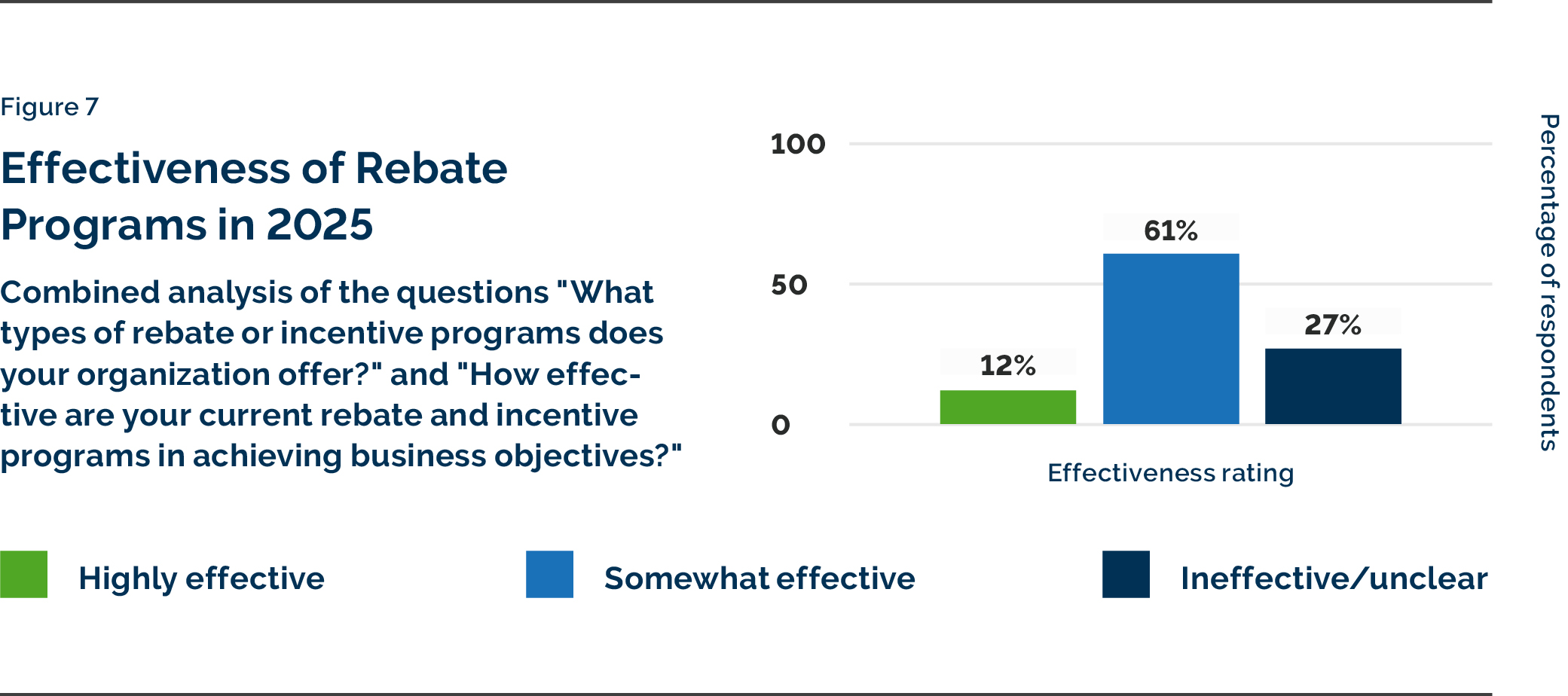
78% of surveyed companies use rebates or incentives, and every respondent reported volume-based structures as part of their program. These programs are easy to track, but miss the opportunity to shape behavior in more dynamic ways. Yet 73% say their programs are effective, which is a sign that value is being delivered even from simpler models (see Figure 7).
The next step is evolution.
More organizations are exploring strategic structures tied to:
- Product mix
- Cross-line growth
- Time- or season-based triggers
- Account-level expansion goals
Academic research supports this direction. A study in the Annals of Operations Research found that seasonal and time-based rebates better align with retailer behavior and demand volatility. And the Journal of Technological Innovations points out that differentiated rebate contracts can outperform flat volume thresholds for driving margin gains.
Incentive Variety Is Growing, But Execution Isn’t
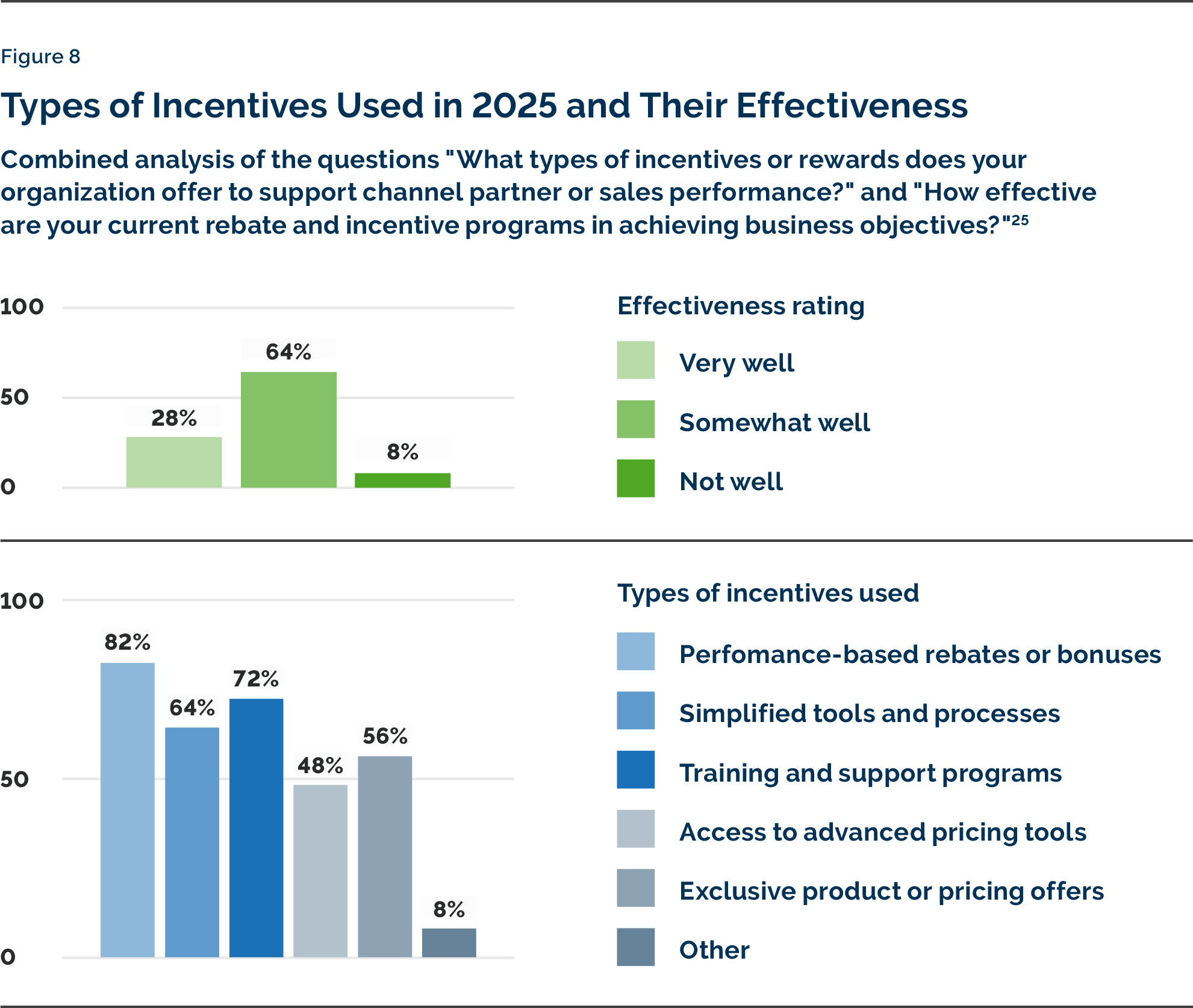
The scope of incentive strategies is expanding among our surveyed companies (see Figure 8):
- 82% offer performance-based rebates
- 72% pair them with training or enablement
- 64% have simplified tools
- 56% offer exclusive pricing
- 48% provide access to advanced platforms
But few have the automation or governance in place to scale these programs without friction. Just 35% of surveyed companies have meaningful rebate automation. That leaves most managing programs with:
- Manual reconciliation
- Spreadsheet tracking
- Disconnected CRM or ERP systems
This slows accruals, creates audit risk, and introduces delays that frustrate partners and internal teams alike.
Automation Is Emerging, But Manual Work Still Dominates
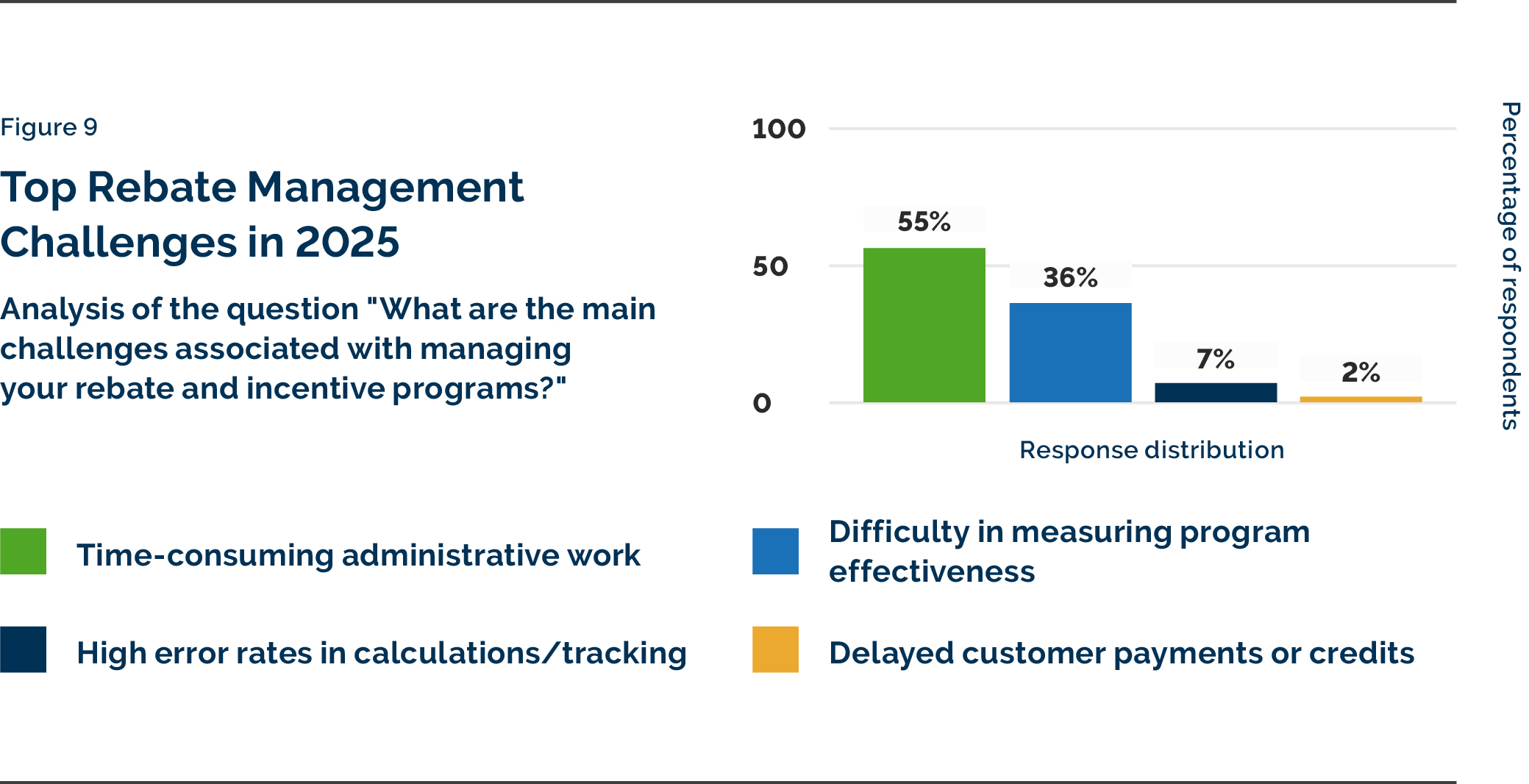
More than half of surveyed companies (55%) describe their rebate programs as “administratively intensive,” with teams juggling spreadsheets, email chains, and disconnected systems to track performance and process payments (see Figure 9).
That level of manual effort is unsustain-able. It eats into time, erodes accuracy, and limits visibility. There are signs of progress, though, as 35% of surveyed companies report having meaningful automation in place. But fully digitized rebate management is still the exception, not the norm.
The gap between potential and practice is clear. Fewer than 10% of respondents report full ROI clarity on rebate programs, a signal that performance data is either difficult to capture or not consistently used to drive decisions.
When teams do automate by integrating rebate logic into core systems and manual reconciliation, the benefits are immediate: smoother settlements, fewer disputes, and faster time-to-value.
Digital infrastructure doesn’t just lighten the admin load. It sets the foundation for strategic scale and smarter decisions across pricing, sales, and finance.
ROI Clarity Remains Low, But Momentum Is Building
With just 9% of surveyed companies reporting full ROI clarity on their rebate programs it’s clear that most companies are still flying blind, executing programs without a clear understanding of what’s working, what’s wasted, and what needs improvement. The issue isn’t a lack of effort. It’s lack of integration. Many organizations are still building out their performance tracking. Attribution remains patchy, and few have the tools to connect rebate spend with real business impact.
But the opportunity is real. Teams that move toward integrated measurement can move faster, course-correct smarter, and build a stronger case for future investment. As rebate ROI becomes more visible, the program’s importance rises across readership.
As famed business consultant Peter Drucker said, “What gets measured, gets managed.” Clear ROI tracking turns rebate management into a strategic lever, one that can support smarter pricing, tighter sales execution, and stronger financial planning.
With each step toward automation and measurement maturity, teams unlock new levers: better program design, faster dispute resolution, and stronger performance signals across sales and finance.
Ownership Gaps Hold Programs Back
Rebate programs often sit in a “gray zone,” touched by many teams but owned by none. Pricing typically designs them. Finance funds and tracks them. Sales negotiates them. But strategic ownership is still elusive. Just 18% of surveyed companies report having a dedicated rebate team.
And when asked who owns performance tracking, not a single respondent pointed to one clear function. Instead, ownership is fragmented:
- Finance is involved in 51% of cases
- Pricing teams participate in 42%
- CRO or sales leadership takes part in 36%
- Executive/c-suite suite plays a role in 23%
This lack of alignment has consequences. Most programs were rated only “some-what effective,” according to our respondents, and are often those with unclear ROI tracking and unchanged structures year over year.
And when volume-based incentives dominate, effectiveness tends to drop further. Rebates become stagnant with-out leadership to challenge stale logic or update program design.
They work, but they don’t improve.
Programs need a clear owner to move rebates from function to force. Someone accountable for performance, empowered to make change, and aligned with commercial strategy.
Essential Action Points
Turn rebates into revenue-driving assets. They aren’t just financial levers. When designed and governed strategically, they shape behavior, protect margins, and create commercial advantages.
- Design beyond volume – Incentivize profitable growth, not just bigger orders. Add layers like product mix, bundling, or partner tiers to align payouts with business value.
- Automate for visibility and velocity – Digitize the full flow from deal structure to payout validation to reduce overhead, boost confidence, and enable live optimization.
- Track what matters – You can’t manage what you can’t measure. ROI tracking tools unlock program clarity, enable agile iteration, and justify investment.
- Assign ownership and accountability – Define clear roles. Pricing owns design and optimization. Finance ensures controls. Sales executes. Align under a shared rebate strategy to maximize results.
About Copperberg AB
Founded in 2009, Copperberg AB is a European leader in industrial thought leadership, creating platforms where manufacturers and service leaders share best practices, insights, and strategies for transformation. With a strong focus on servitization, customer value, sustainability, and business innovation across mainly aftermarket, field service, spare parts, pricing, and B2B e-commerce, Copperberg delivers research, executive events, and digital content that inspire action and measurable business impact.
Copperberg engages a community reach of 50,000+ executives across the European service, aftermarket, and manufacturing ecosystem — making it the most influential industrial leadership network in the region.